

Date: 16 Dec 2023
‘Hi. I would like to raise funds for my business. Something like $5-$15M from Silicon Valley. Is this possible?
I don’t have any idea how this works and would like to ask you some questions.’
This is what I said to a prominent venture capitalist from Sequoia Capital- one of the most successful funds in the world.
We were at his house sitting on the table, where I gathered the most crucial information for my fundraising strategy. I knew it was unlikely for this person to fund Team-GPT. So I went on to ask him a bunch of questions.
I was taking notes the whole meeting.
This article goes into all the questions I asked and the answers this VC gave me.
I’ve heavily based the fundraising process of Team-GPT (raised $4.5M) on this information.
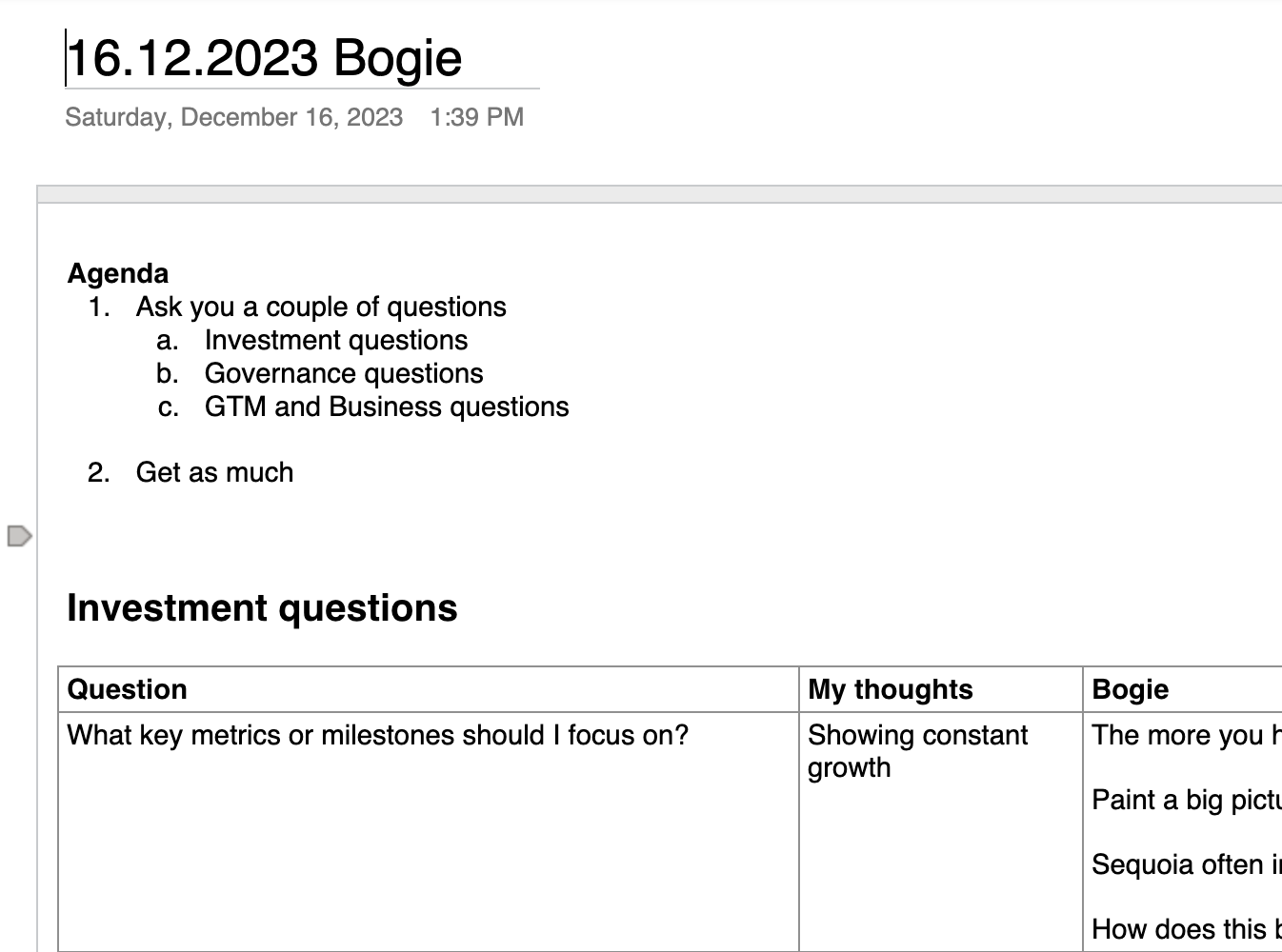
Here are the questions + key findings.
What key metrics or milestones should I focus on?
Show constant growth
Paint a big picture and tell a compelling story
Focus on how this becomes $500M ARR in 10 years
The more metrics you have, the better
How to target investors?
Talk to founders and get warm introductions to VCs
Start having informal meetings with investors way before you fundraise
Develop relationships now, as most investors are in for the next 10 years
Be prepared for “We are not investing yet but...” conversations
What are realistic amounts of capital to raise in a first round?
For first-time venture-backed entrepreneurs, $15M is likely too much
Start with Seed and target $0-$3M.
It’s supply and demand. If more people want your deal, you will likely get a better price
What kind of due diligence should I expect from investors?
You should know all the common ones by heart (ARR, #users, MAU, etc.)
Do cohort analysis
30d, 60d, 90d retention of different cohorts
Who leads the round - does it matter and why?
It matters significantly
Every lead investor in Seed optimizes around ownership
Whatever you raise will likely cost 20% of the company
Everybody hates co-leading (10% for one investor, 10% for another doesn’t make sense for anyone)
How to choose lead investor?
Main decision: “Do we like you, do we like the idea”
For Seed round, look for: Outlier founder (most important) with Unique and compelling insight in an Area where you can build a large business
Ask yourself: What investors do you want to have on the cap table?
Timeline for raising?
Be conservative, 1-6 months, brace for 3 months
Most time-consuming part is getting to the first term sheet. You just need one.
Thoughts on Business model?
Don’t set your price low
Aim for around $50/user/month
The moment you set your price, you set your target market
What are the key considerations for the Board of Directors?
It’s Seed round - YOU (the CEO) are the board.
OpenAI’s recent issue is just one of many examples of board-related problems but these will come later
Where should the company be incorporated?
Incorporate in Delaware. Full stop.
What are some examples of Sequoia’s recent investments?
Sequoia just invested $15M in a company that doesn’t have revenue
Why? The founder had several successful exists that made money to their investors
Examples of people who can raise $15M on an idea:
Ofir Ehrlich (LinkedIn profile: https://www.linkedin.com/in/ofirehrlich/)
Assaf Rappaport (LinkedIn profile: https://www.linkedin.com/in/assafrappaport/)
Additional note:
Wiz (company founded by Assaf Rappaport) raised significant funding from the get go
Sequoia is willing to invest large amounts ($15M) in pre-revenue companies
Founder track record is highly valued (multiple successful exits)
Successful founders can raise substantial amounts even without current revenue
How does Sequoia approach investments?
Sequoia makes about 20 investments, totaling $700M
10% of these investments drive the returns
They invest with very high conviction (translation: they need to be super-duper sure you are a winner!)
How should I frame my pitch? The VC advice on Team-GPT:
Don’t lead with “ChatGPT is difficult to adopt” as it won’t resonate with investors. ChatGPT is perceived as a good product
Focus on the transition from single player to multiplayer
Emphasize the shift from personal to company-wide story
What narrative should I build? The VC suggestion:
Enterprise communications have only been people-to-people
Going forward, it will be people-to-people and people-to-machine
There needs to be a new enterprise chat system that mixes both
What should I emphasize about myself?
Focus on why I am the person who will build this company -> you are the CEO and have to show you are ‘calling the shots’
Sequoia would invest in companies based on “Act 1” (the founder’s background and vision)
Key analogies for Team-GPT:
Slack is great for human-to-human communication
There needs to be a new enterprise chat system that incorporates both people-to-people and people-to-machine interactions
How should we structure the initial equity distribution?
In the beginning, founders are getting everything
What about early investors?
It’s better for me to have preferred stock than common stock -> later it turned out that founders always get common stock
How much should we allocate for the stock option pool?
Stock option pool should be 10-15-20% of the company
At the end I had written Next Steps
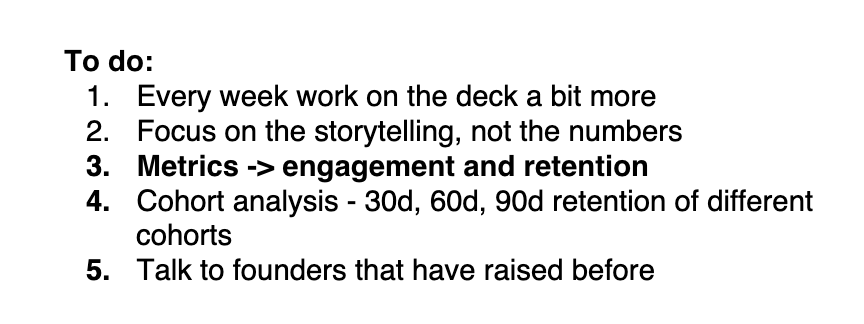
To do:
Every week work on the deck a bit more
Focus on the storytelling, not the numbers
Metrics -> engagement and retention
Cohort analysis - 30d, 60d, 90d retention of different cohorts
Talk to founders that have raised before
Talking to other founders
Indeed talking to founders was crucial.
I set a goal to meet 25 founders.
I met about 15.
These founders told me everything I needed to know about the fundraising process.
The Sequoia VC told me that books will be a waste of time.
I disagree then and now.
Read these 3 books before starting to fundraise:
They’ll help you think like a VC!
Thanks for reading and good luck fundraising!